
We serve an AWESOME God!
The more I learn about Him, the more awesome He becomes to me.
– Chandra Hronchek, your hostess for In His Image Bible Study
Reading Assignment
Genesis 1:1 to Genesis 2:4
Matthew 14:16-21
Matthew 15:29-38
John 2:1-11
These are the generations of the heavens and of the earth when they were created, in the day that the Lord God [Elohim] made the earth and the heavens…
Genesis 2:4
Elohim: the Master Creator
God is the Master Chemist, the Master Biologist, the Master Physicist, the Master Geologist and on and on. But these terms were not in existence when God created the heavens and the earth. They were invented by mankind as we stretched our creative suspenders to strive to discover just what God created and how to use it and manipulate it. We are the ones who became chemists, biologists and other scientists to delve into the depths of what God did. All that the patriarchs knew of God was by the way he introduced himself to them in a term that they were able to understand: Elohim – the Mighty One, the Creator God.
What, precisely, did God do when He created? Let’s try to get a deeper understanding by examining the creation account, starting at Genesis 1:1 and ending at Genesis 2:4. But before we even begin, there is another question that needs to be addressed: How did this creation account even come into existence if no one was there to see it? It all happened before man was created, before there was any flesh-and-blood person who could be an eyewitness.
Historically, this account has been attributed to Moses. But how did Moses get this information? He lived many, many years later. Some think that God, Himself, wrote it on stone tablets. After all, God wrote on stone tablets (twice) when He gave Moses the Ten Commandments, so He certainly could have left His account with Adam in this way. What clues can we find in the Genesis account?
Elohim: the Writer
Many people think that there are two separate Creation accounts in Genesis, but if you look at the form of the writing, you can see that it is the same account, but written from two different points-of-view, God’s and Adam’s. God put his signature on his part of the narrative when he said:
These are the generations of the heavens and of the earth when they were created, in the day that the Lord God (Jehovah Elohim) made the earth and the heavens… (Genesis 2:4)
This particular literary device, or signature, has been dubbed the Colophon and, historically, was commonly found on tablets and scrolls. When a scribe wrote on a clay tablet, he would put his signature at the bottom. If a second writer continued the same chronicle on another tablet, he would key his writings to the previous tablet by some identifying word of phrase which corresponded to the closing portion of the previous tablet. Even today, colophons are used in publishing as a statement giving information about the authorship and printing of a work.
When you read further in Genesis, you will discover that it contains sections that were written by different authors, each being identified by the colophon, or signature, of the writer, and keyed to the previous section as an ongoing chronicle. Each of these colophons puts a finalization to the events that were written previously.
SIDE NOTES
The Colophon
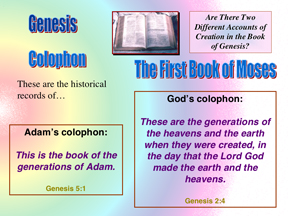
Genesis 2:4 The creation account from God’s point of view.
Genesis 5:1 Adam’s colophon signifies what Adam experienced. This is the book of the generations of Adam.
Genesis 6:9 Noah’s colophon. These are the generations of Noah.
Genesis 10:1 Now these are the generations of the sons of Noah, Shem, Ham, and Japheth.
Genesis 11:10 These are the generations of Shem…
Genesis 25:12 These are the generations of Ishmael…
Genesis 25:19 These are the generations of Isaac…
Genesis 36:9 And these are the generations of Esau, the father of the Edomites …
Genesis 37:2 These are the generations of Jacob.
Generation to Generation
The writing of the first five books of the Bible, (the Torah) is attributed to Moses, with the book of Genesis being called The First Book of Moses. How did he write this? He was not there, was he? How could he know this information, living so long after these events occurred?
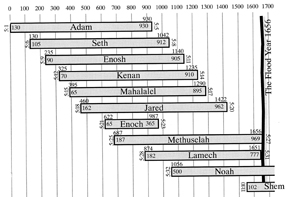
The only possibility is that the people who lived in that time must have recorded the information and passed it on for future generations. Indeed, if you look at the timeline of the lifespans of the patriarchs before the flood, Adam, who had a lifespan of over 900 years, was still alive during the lifetimes of all of them. Noah was the only one of the patriarchs (before the flood) who was born after Adam died.
This amazing fact means that every one of the patriarchs had direct access to the creation story through the eyewitness account of Adam. Doesn’t it seem reasonable to assume that these written accounts made it onto the Ark? Since we have no way of knowing whether this is indeed the case, we have to assume that this was a people who valued their history and knew how to preserve it for future generations, and so found a way to pass it forward. After all, we have the evidence of the existence of other historical documents, such as the Dead Sea Scrolls, to give us insight as to how much they valued the preservation of their past.
Super-Long Lifespans found in Genesis
God’s Attribute: Elohim the Creator
When God first revealed himself as Jehovah Elohim, he was not known by any other name. Indeed, His early people didn’t even know his name. They only knew him by his title, Elohim, The Creator.
What did they understand about Elohim?
They did not have labs, textbooks, scientific instruments or other means to measure and dissect what God said He had done. They had only His word.
In the beginning, God created the heaven and the earth. Genesis 1:1
Just for a few minutes, let’s suspend theology and everything we think we know about the Bible and look at this passage as a purely factual statement. It was meant to convey information to a people who knew only what they heard and saw. Mankind at the time did not have the scientific knowledge and training to be able to examine what God did at the level that we have today.
In the beginning
Elohim created the
heaven and the earth
Did you know?
Elohim is actually the plural of the word Eloah. God, from the beginning, referred to Himself in the plural. Right at the start, He was giving clues as to His triune nature. Although the Hebrews always have known that they worshiped One God, this use of the plural has prompted a lot of theological discussion.
God created time
In the beginning. The Bible doesn’t simply start out with ‘God created the heavens and the earth’ but it adds in the aspect of a beginning to everything.
God is eternal, so it is reasonable to think that ‘the beginning’ refers to the beginning of time. You might want to think of time as a dimension, like a window, in the midst of eternity. So Genesis 1:1 says In the beginning (right at the start) God created the heaven and the earth.
In the beginning…
God created space
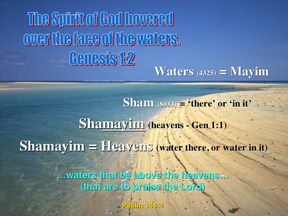
The original Hebrew word for heavens is SHAMAYIM – it is the sky that we see that holds the sun, moon and stars. MAYIM means waters, while SHAM means there or in it, so SHAMAYIM simply means water there, or water in it. On the second day of creation (verse 6), God established the firmament to divide the waters above from the waters below. He called the firmament Heaven, or Shamayim. This was the descriptive term that Elohim used to describe the stretched out space that He made to divide the waters. In other words, He even had to make the space to put everything in!
God created the heavens …
God created matter
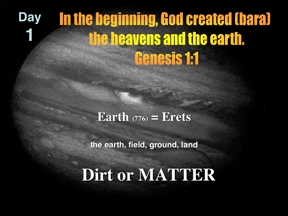
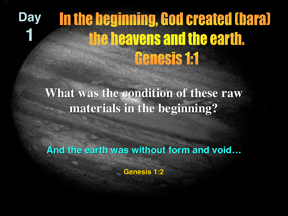
The original Hebrew word for earth is ERETS which simply means dirt, or the raw materials from which everything else is made. What was the condition of these raw materials? Genesis 1:2 says:
And the earth was without form, and void…
When you have building materials for any project, right at the beginning there is no form to them. It takes a master builder/architect with a plan to take those raw materials and make them into something usable.
When God created the earth, the physical structure of matter had apparently not yet been organized and the earth was truly empty or void of the things necessary for life. Think of it as piles of electrons, neutrons and protons just lying around, waiting to be made into something useful.
God created the earth …
God created energy
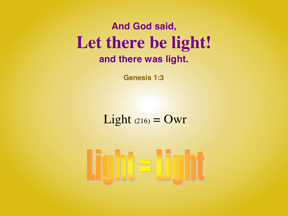
And God said, Let there be light. And there was light. Genesis 1:3
Then spake Jesus unto them, saying, I am the light of the world … John 8:12
The Hebrew word for light (OWR) just means light. But this was still the first day of creation – the sun and stars were not created until the fourth day. So how could there be light?
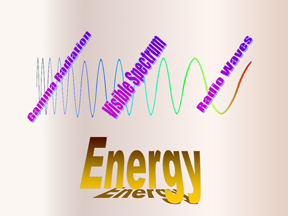
What is light, really, but energy. It is a part of the electromagnetic spectrum which goes from short wave gamma rays to long radio waves. Electromagnetic radiation includes a vast range of frequencies such as x-ray, ultra-violet, infrared and microwave. Visible light is only a part of this spectrum, so light is simply part of the electromagnetic spectrum – it is the narrow band of color that we are able to ‘see.’
When God said ‘let there be light’ what did He create? Energy! As soon as He said ‘let there be light’ all of those electrons started racing around. At that instant, matter was energized, basic elements took on specific form. Atomic particles were now in motion and operating in TIME.
Let there be LIGHT!
Jesus holds us all together
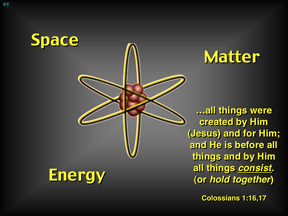
There is a paradox that still puzzles scientists today, and that has to do with the structure of the atom. Recall from your school days, that an atom is composed of a nucleus with electrons racing around it. In that nucleus, there are protons and neutrons. Protons are positively-charged particles.
If you have ever played with magnets, you may have noticed that the positive ends of the magnets repel each other. So how do all of these positively-charged particles stay together within the nucleus? They should repel each other and the entire nucleus should fly apart, right? But we can find a clue to this enigma in Colossians (remember, we are considering the Bible as a factual text for the moment). Speaking of Jesus,
… all things were created by Him and for Him; and He is before all things and by Him all things consist. (hold together – NIV) Colossians 1:16-17
The word consist in the King James version of the Bible is from the Greek, SUNISTAO, meaning to strengthen or set together. The New International Version interprets this word as hold together. So it is Jesus who holds all things together. That’s pretty miraculous!
All things hold together
Let’s finish up
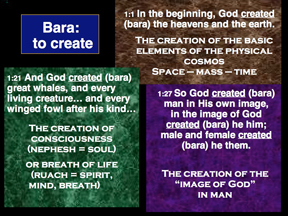
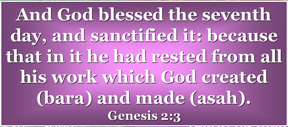
In the first chapter of Genesis, God created many many things, including the galaxies, the firmament, the plants, the animals, and man. But according to the original Hebrew word for create, God created only five times. Everything else was either made or formed from what He had already created.
Bara: The Hebrew word, bara, means ‘create’ or ‘created.’
Verse 1: God created time, space and matter.
Verse 21: God created the animals. He did not create the materials to make the animals because He had already created those. What He created was the self-awareness, the consciousness.
Verse 27: God created man in his image. He did not create the materials to make his body, nor the consciousness that became his awareness because those had already been created. What He created was the image of God in man, the spirit of man. Man is uniquely created with the capacity for God-likeness.
Every human reflects the triune nature of God:
Body – the matter that makes a solid form;
Soul – the consciousness, the self-awareness, the ability to make decisions and develop personality;
Spirit – the image of God in man.
Bara: Created (from nothing)
What about the plants and animals, and the universe?
Because He did not need to ‘create’ the raw materials again, God used what he had already created and made and formed it into everything else in existence.
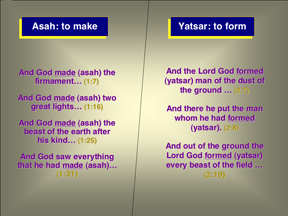
Asah: The Hebrew word, asah, means make or made.
Verse 7: God made the firmament
Verse 16: God made the two great lights and the stars
Verse 25: God made the beasts and the living things
Verse 26: God made man in His image.
Verse 31: God saw everything that He had made …
Yatsar: The Hebrew word, yatsar, means to form, or formed. Yatsar is not used at all in Genesis 1, however it is used elsewhere in a creative sense:
Genesis 2:7: God formed man
Genesis 2:19: He formed every beast and bird
Made and Formed
(from created matter)
How did Jesus reflect the creator-attribute of God?
When Jesus walked the earth as a man, He was able to do all of the things that God had originally empowered mankind to do. So, why weren’t the people of that era doing the things that Jesus did and why don’t we do them today?
Jesus was sent to earth to open up salvation to us, but he was also here to reflect and demonstrate the character of God in man. He was anointed for this purpose, to demonstrate to us how to walk in all aspects of God’s likeness. The difference between His walk and our walk, may simply be the difference between knowledge and ignorance, faith and doubt. After all, Jesus spent a lot of time in prayer. God must have revealed to him the specific aspects of creation that he could control and how to do it.
Think of the time that Jesus miraculously turned the water into wine at the wedding at Cana (John 2:1-11) and the times that he fed the multitudes (Matthew 14:19; Matthew 15:36). He was not doing bara creative events, but rather yatsar creative events – a re-forming of the elements already available, to make them into something that was useful.
This beginning of miracles did Jesus in Cana of Galilee … John 2:11
And they all did eat and were filled … Matthew 14:20
And they that did eat were four-thousand men, beside the women and children. Matthew 15:38
Jesus made and formed
When you think about it, all foods, plants and water are made up of only a few elements. Carbon, hydrogen and oxygen make up carbohydrates and fats. Add in nitrogen and sulfur and you can have amino acids and proteins. Add phosphorous and you can have the nucleotides, which form the genetic materials, DNA and RNA. Add in some trace minerals and you can have enzymes, cofactors, hormones, and all the rest. All of these elements can be found dissolved in water and are also in the air and in the dust that permeates the air.
As Jesus performed these miraculous events, I have often envisioned Him blessing the food as he held it up to the heavens. I wonder if he was showing the angelic host the template for what needed to be made, as if saying, ‘here is the pattern for you to follow to put these things together for us.’ Then, acting in faith, he broke the bread while the angels raced around to gather and to rearrange and knit together the elements from the air into the food for the people.
Aside from the miraculous, Jesus was also very creative in the way he dealt with people and situations. He often flummoxed the people in authority because of his unorthodox (creative) approach to matters. Today we might call it ‘out-of-the-box thinking. Jesus used creative storytelling – parables – to convey the truths about God. Do you think that, by using this method, he was able to engage people’s imaginations and help them have a better understanding of themselves and their relationship to God?
What other events that you can think of that demonstrated his creative way to challenge the prevailing mindsets?
The Simplicity and the Complexity
Carbon + Hydrogen + Oxygen =
Carbohydrates & Fats
—
Carbon + Hydrogen + Oxygen +
Nitrogen + Sulfur =
Amino acids, proteins & enzymes
—
Carbon + Hydrogen + Oxygen +
Phosphorous =
DNA & RNA
How do YOU reflect God’s creativeness?
Genesis 1:26 says that God made man after His likeness. This means that whatever God has revealed as part of His nature, or likeness, He has put something of that into each and every person. That being said, we have just looked at the amazing creative capacity of Elohim. It is in His nature to be creative.
Realizing that we all have different aspects and different measures of Elohim’s creative attribute, how do you think YOU manifest creativity? You may say ‘Oh, I’m not creative at all,’ but creativity encompasses more than just the arts. Look at the accompanying short list. Every one of these activities requires creativity. Do you fall somewhere within this list, or is your area of creative expertise somewhere else?
Your own creative talents are an attribute of Elohim that you have simply because you are made in His likeness, just as the creativity of others is due to their God-likeness. Doesn’t it give you a greater respect for yourself and others when you realize this, that God has placed part of His nature into every human?
• Organization & Arranging
• Writing & Composing
• Artistic endeavors
• Construction & Architecture
• Trades
• Teaching/Administration
• Acting/Performing
• Finances
• Cooking
• Parenting
• Retail & Marketing
• Survival tactics
• Military strategy
• Prayer strategy
• Athletics
Questions for thought and discussion
Do you think your God-endowed creativity can be developed and strengthened?
Do you think it can be weakened or lost or perverted?
Do you think everyone has the same amount of creativity?
What do you consider to be your creative strengths?
Do you have areas where you wish you were more creative?
For further study
The knowledge that Elohim is the Creator God is fundamental to faith. Elohim is referred to as Creator and praised for His creation throughout the scriptures. To read through some of these, click this link for some more relevant scriptures.
References:
The Holy Bible: King James Version
Dennis Peterson, Unlocking the Mysteries of Creation (Book)
Slides by Chandra Hronchek from Unlocking the Mysteries of Creation (Seminar)
©2025 Chandra Hronchek